Hotel CRM: guest profiles, booking history and corporate accounts in one system
Short answer: a hotel CRM is a single database of guests, their bookings, payments and the companies that send them. In uMehmon the CRM is not a separate add-on: passport-based guest profiles, the full history of every booking, corporate accounts with discounts and receivables, and a tamper-proof audit log all live inside the PMS. Email campaigns and a loyalty programme are not available yet — they are on the roadmap, and we say so plainly below.
What is a hotel CRM, and how is it different from a contact list?
In many independent hotels the "customer database" is a spreadsheet, a notebook at the front desk or the contacts on a manager's phone. That list stores a name and a phone number, but says nothing about when the guest stayed, how much they paid, which company booked them or who last edited their record.
A CRM (Customer Relationship Management system) connects customer data to bookings, payments and documents. For a hotel that means answering three questions quickly: who is this guest, what is our history together, and how much revenue does this guest (or their company) bring in — or owe?
General-purpose CRMs were designed for sales teams: deals, pipelines, calls. In a hotel the "deal" is a reservation, the key document is a passport and, in Uzbekistan, the E-mehmon registration, and the key financial object is the folio and invoice. That is why a hotel CRM delivers the most value when it shares one database with the Hotel PMS: nothing is typed twice and nothing gets lost in a sync between two systems.
What uMehmon already does as a hotel CRM
Everything below is available in the product today. It is part of the hotel management system and needs no separate installation.
Guest profiles with passport data
Each guest record stores passport details: full name, date of birth, citizenship and document number. For Uzbek citizens the details can be filled from the Ministry of Internal Affairs database by passport number, which removes typing errors. For international guests, visa and border checkpoint (KPP) details are recorded.
The profile is more than a contact card. At check-in it is used to register the guest automatically in E-mehmon, the national guest registration system. At check-out the system asks whether to deregister the guest from E-mehmon as well. If E-mehmon does not respond, the request goes into an automatic retry queue, and a registration number can also be entered manually. Every submission is visible in the E-mehmon log.
Booking history — per guest and per booking
Every booking keeps a complete history: when and by whom it was created, whether the guest was moved to another room (and why), whether the stay was extended, a paid late check-out added, or the booking cancelled and restored. When a guest returns, the front desk can see previous stays and tailor the service.
Group bookings keep several rooms under one name, so the whole group can be checked in, checked out or cancelled in one action — useful for hotels that work with tour operators and corporate events.
Corporate accounts: discounts and receivables
A company card holds legal details, a discount percentage and the billing rule: "company pays" or "guest pays". When a booking is made under that company, the discount is applied automatically, so the front desk never recalculates by hand.
Balances on company-paid bookings are tracked as accounts receivable. Invoices are generated on your letterhead with logo, legal details, tax ID (STIR), bank details, the amount in words and sequential numbering such as INV-2026-00001. They can be printed or sent as PDF.
The folio: the guest's account
The folio shows every charge, payment and the outstanding balance. Payments can be taken in cash in UZS or foreign currency (USD, EUR, RUB), by Uzcard, Humo, Visa or Mastercard, via terminal, bank transfer or online. A cash transaction can never be deleted — only voided with a stated reason — so the payment history with each guest is always complete.
Activity log (audit trail)
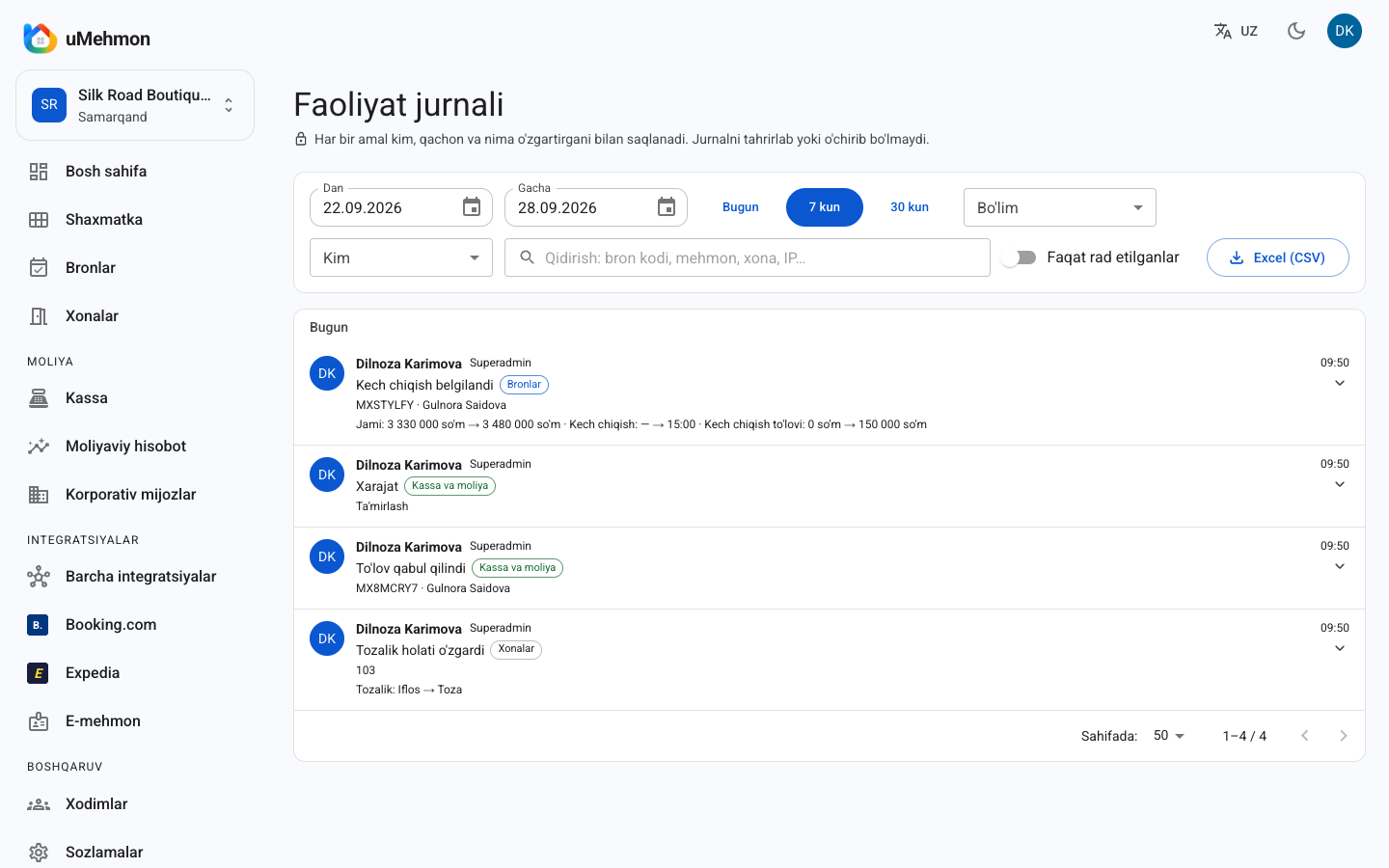
Every action is recorded: who, when and what changed (old value → new value). The log cannot be edited or deleted, and it can be exported to CSV. For CRM purposes this matters: if a guest disputes a rate or discount, you find out in seconds who changed it and when.
Guest analytics
The hotel analytics module calculates number of guests, revenue per guest, corporate share, direct and OTA share, average discount and cancellation rate — each compared with the previous period — so you can see whether your corporate relationships are actually paying off.
The guest journey: what the CRM does at each stage
The easiest way to understand a hotel CRM is to follow one guest from booking to return visit.
| Stage | What happens in uMehmon | Where it pays off later |
|---|---|---|
| Booking | Booking created (direct, phone, OTA or walk-in), company selected, discount applied | Lead time, channel mix, corporate share |
| Prepayment | Payment posted to the folio, visible in the cash desk in real time | Balance and collection rate |
| Check-in | Passport details saved to profile, E-mehmon registration sent automatically | Guest profile, E-mehmon log |
| Stay | Room moves, extensions, extra services | Booking history, revenue per guest |
| Check-out | Folio closed, E-mehmon deregistration, room marked dirty | Invoice, receivables, housekeeping |
| Return visit | Profile found by passport, full history visible | Personal service for repeat guests |
At every stage data is entered once and flows to the next. That is what separates a CRM built into the PMS from a separate spreadsheet or a generic CRM: the front desk never asks the guest the same question twice, and the accountant never reconciles three files to find a debt.
Guest data security
Passport data is personal data, and access to it must be controlled. uMehmon handles this on several levels:
- Roles: each staff member sees only the sections their job requires.
- Data isolation: even with several properties in one account, each guest database is kept separate.
- Sessions and encryption: integration keys are stored encrypted and staff sessions are managed.
- Audit log: you always know who opened and edited a guest record.
- Staff management: a departing employee can be removed and passwords reset in seconds.
Keeping guest data in a spreadsheet and passing it around in a messenger is common, but it is the riskiest option: files get copied and lost, and nobody can tell who opened them. In a cloud system the data lives in one place with controlled access.
What is not available yet
The CRM side of uMehmon focuses on the operational and financial relationship with guests and companies. The following are not in the product today and sit on the roadmap:
- Email and SMS campaigns (automated sends, segments)
- Loyalty programme (points, tiers, repeat-guest cards)
- Automated post-stay surveys
- AI-driven recommendations (see AI for hotels)
If you need marketing automation now, you can use your guest list in an external email tool — only with guest consent and in line with personal-data law.
Comparison: spreadsheet vs generic CRM vs uMehmon
| Criterion | Spreadsheet / notebook | Generic sales CRM | uMehmon (CRM inside the PMS) |
|---|---|---|---|
| Passport details | Manual, error-prone | Custom fields to configure | Built in, filled from government database |
| E-mehmon registration | Separate, manual | Not available | Automatic at check-in |
| Booking history | None or scattered | Requires PMS integration | Per booking and per guest |
| Corporate discount | Calculated by hand | At deal level | Automatic from company card |
| Company receivables | Separate sheet | Requires accounting integration | Receivables and invoices built in |
| Who changed what | Unknown | Partial | Tamper-proof audit log |
| Email campaigns | No | Usually yes | Roadmap |
| Loyalty programme | No | Sometimes an add-on | Roadmap |
The takeaway: if your priority is clean guest records, E-mehmon compliance, corporate partners and debt control, a CRM inside the PMS is far simpler than stitching two systems together. If mass marketing campaigns come first, you will need an external tool for now.
Pros and cons
Pros
- Data is entered once: booking, passport, E-mehmon, folio and invoice share one database.
- Corporate discounts and billing rules apply automatically, removing front-desk errors.
- Company balances are visible in real time and invoices are ready in seconds.
- The tamper-proof audit log settles disputes quickly.
- No separate CRM licence or integration cost — it is included in every plan.
- Cloud-based: runs in the browser on phone, tablet and desktop.
Cons and limitations
- No email/SMS campaigns or loyalty programme yet.
- The interface is in Uzbek and Russian; an English interface is not available yet.
- Online payments (Payme/Click) and fiscal receipts (OFD) are still in development.
- No built-in automated guest messaging or surveys.
Numbers and formulas: measuring CRM impact
Judge a CRM by numbers, not impressions. The formulas below match metrics in uMehmon analytics.
| Metric | Formula | What it tells you |
|---|---|---|
| Corporate share | Corporate room revenue / Total room revenue × 100% | Dependence on company business |
| Revenue per guest | Total revenue / Number of guests | Average value of a guest |
| Average discount | (List-rate total − Actual total) / List-rate total × 100% | How much discounting costs you |
| Collection rate | Cash received / Room revenue × 100% | How much of earned revenue was collected |
| Direct share | (Direct + phone + walk-in revenue) / Room revenue × 100% | Share of revenue without OTA commission |
Example: monthly room revenue is 120 million UZS, of which corporate bookings are 36 million. Corporate share = 36 / 120 × 100% = 30%.
Example: monthly room revenue is 120 million UZS and 108 million was received at the cash desk. Collection rate = 108 / 120 × 100% = 90%; part of the gap is typically unpaid company invoices, which show up in receivables.
Example: a company on a 10% discount books 40 room nights a month at a base rate of 500,000 UZS. Discount cost = 40 × 500,000 × 10% = 2 million UZS. If those rooms would otherwise stay empty, the discount pays for itself — check it against your occupancy rate.
Quick Q&A
Q: How do I recognise a repeat guest? A: Through the guest profile and booking history — a passport search shows all previous stays.
Q: Can I see all employees of one company together? A: Yes. Bookings are linked to the company card, so all its bookings and balances appear in one place.
Q: Do OTA guests end up in the database too? A: Yes. A booking from the channel manager is placed into a free room automatically, and the guest's passport details are added to the profile at check-in.
Q: Are profiles kept for hostel guests? A: Yes. In hostel mode every guest has a separate booking and a separate E-mehmon registration.
How to run guest relationships in uMehmon
1. Start with data quality
A CRM is only as good as its data. Filling passport details from the government database and registering guests in E-mehmon automatically at check-in keeps the database clean.
2. Structure your corporate partners
Create a card for every partner company and set discounts only there, so pricing policy does not depend on who is on shift. A rate range (min–max) adds another safeguard: any rate outside the range needs manager approval.
3. Assign roles properly
Front Desk handles bookings and check-in, Finance handles the cash desk and invoices, Managers handle rates and approvals. Directors and the Superadmin see the full picture, including the audit log.
4. Review receivables weekly
A weekly look at outstanding balances and re-sending invoices to late payers keeps the collection rate healthy.
5. Track results in analytics
Each month, compare corporate share, average discount and revenue per guest with the previous month. If discounts rise while corporate share does not, it is time to revisit your discount policy.
Moving from spreadsheets to uMehmon
Many hotels delay switching because they fear losing years of spreadsheets. In practice you can migrate in stages. Start with corporate partners — usually a handful of companies that bring in the most revenue. Then move future bookings onto the tape chart. Guest profiles fill up naturally, as every new arrival is added with passport details at check-in.
Keep the old spreadsheet as an archive, but set one rule: new data goes into the system only. Within a month or two your key guests and partners are in the database, and analytics starts showing real numbers.
Who it is for
- Small and mid-size hotels (10–300 rooms) that work with corporate clients.
- Hostels — with a separate guest and E-mehmon registration per bed.
- Apart-hotels — for long-stay guests and company staff (apart-hotel PMS).
- Multi-property owners — several hotels in one account, each with isolated data.
Pricing
| Plan | Price (per month) | Rooms | Staff | CRM features |
|---|---|---|---|---|
| Trial | 14 days free | up to 30 | — | Everything |
| Start | 290,000 UZS | up to 10 | 2 | Profiles, history, corporate, audit |
| Pro | 590,000 UZS | up to 40 | 10 | + channel manager |
| Business | 990,000 UZS | up to 300 | 50 | + channel manager |
Conclusion
A hotel CRM does not have to be a complex marketing suite. For most properties the biggest gains come from an organised guest database, the history of every booking, transparent billing with corporate partners and a log that shows who changed what. uMehmon delivers exactly that in one system alongside the PMS, E-mehmon and cash desk, with marketing automation coming in a later stage. For the concept in depth, read what is a hotel CRM.
Start a 14-day free trial — sign up and bring your guests, bookings and corporate accounts into one system today.
How to set up a hotel CRM in uMehmon
- 1
Sign up
Create an account at umehmon.uz/register and start the 14-day free trial.
- 2
Add rooms and staff
Enter room types, rooms and rates, and give staff the Manager, Front Desk or Finance role.
- 3
Create corporate accounts
Add a card for each partner company with its legal details, discount percentage and billing rule.
- 4
Complete guest profiles at check-in
Enter passport details or fill them from the government database so the profile is ready for E-mehmon registration.
- 5
Monitor history and balances
Check history on the booking and guest cards, receivables on the company card and every change in the activity log.
- 6
Measure results in analytics
Compare corporate share, revenue per guest and average discount with the previous period.
Frequently asked questions
A hotel CRM is a system that keeps guests, their bookings, payments and relationships with partner companies in one database. It tells you how often a guest has stayed, how much a company owes you and which staff member changed what.
No. Guest profiles, booking history, corporate accounts and the audit log are part of the PMS on every plan. There is no separate licence or add-on fee.
Passport details are stored on the guest profile and used at check-in to register the guest automatically in E-mehmon, Uzbekistan's mandatory guest registration system. Uzbek citizens' details can be filled from the Ministry of Internal Affairs database by passport number, and visa and border-crossing data are recorded for foreign guests.
You set a discount percentage on the company card and it is applied automatically to every booking made under that company. The card also defines who pays: the company or the guest.
Balances on company-paid bookings are tracked as accounts receivable. Financial analytics shows the total receivables figure, and invoices can be printed on your letterhead or sent as PDF.
Not yet. Email campaigns, loyalty points and marketing automation are on the roadmap. Today the system covers the guest database, booking history, corporate accounts and analytics.
Yes. The activity log records who did what and when, including the old and new value. The log cannot be edited or deleted and can be exported to CSV.
Access is controlled by roles: Superadmin, Director, Manager, Finance and Front Desk. Each property's data is isolated, so another hotel under the same account cannot see it.
Try uMehmon free for 14 days
Tape chart, reservations, cash desk, E-mehmon and Booking.com — in one platform. No credit card required.
Start free trial