Hotel Booking Engine: How to Win More Direct Bookings
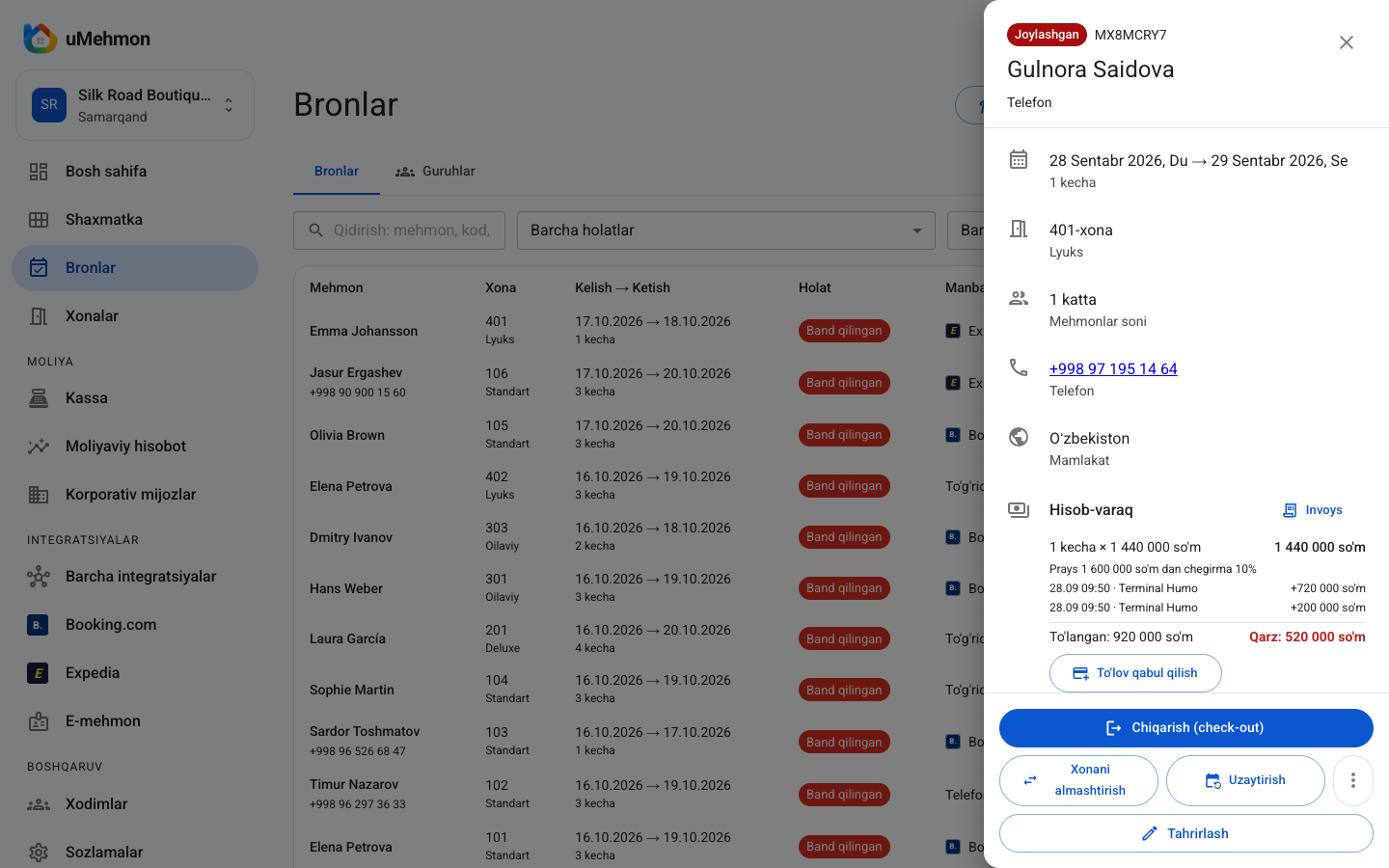
Short answer: a hotel booking engine is the reservation module on your own website that lets guests book and pay directly, without an OTA in the middle. It lowers commission costs, gives you the guest's contact details and makes your website a real sales channel. uMehmon's own Booking Engine is currently in development; today uMehmon already provides the PMS, chessboard, price ranges, channel manager and analytics that a direct booking strategy depends on.
This page explains how booking engines work, why they matter for independent hotels, hostels and guest houses in Uzbekistan and Central Asia, how to evaluate one, and exactly what you can do with uMehmon right now.
What is a hotel booking engine?
A booking engine is software that turns your website from a brochure into a shop. A visitor chooses dates and the number of guests, sees which rooms are available and at what price, and confirms the reservation online. In a well-integrated setup, that reservation lands directly in the hotel's property management system (PMS) and the room disappears from every other channel.
Most booking engines are delivered as a widget or a hosted page. The widget is a search box (dates, guests, promo code) that you place on the homepage; the hosted page shows rooms, rates, photos, policies and the checkout form. The guest never leaves your brand, and you are not paying a percentage of the room revenue to a third party.
For a deeper, non-product introduction to the concept, read our blog article What is a booking engine.
How does a direct booking actually flow?
- A guest finds your hotel through Google, Instagram, a friend or even an OTA listing.
- They open your website and enter dates in the booking widget.
- The engine asks the PMS for live availability and the applicable rate.
- The guest selects a room, enters personal data and pays or leaves a guarantee.
- The reservation is created in the PMS, the room is blocked on the tape chart and a confirmation email is sent.
- The channel manager pushes the updated availability to Booking.com, Expedia and other connected sites.
The last step is what separates a professional setup from a risky one. If the booking engine keeps its own separate inventory, a room sold on your site can still be sold on an OTA a minute later.
Why do hotels need a booking engine?
Lower distribution cost
Every OTA reservation carries a commission. A direct booking carries only your own costs: payment processing, website hosting and marketing. The formula for net revenue from a booking is simple:
- Net revenue = Room revenue − Commission − Payment fees
Because commission is applied to every OTA booking, even a small shift toward direct sales changes your margin.
Ownership of the guest relationship
When a guest books through an OTA, the platform controls communication and often masks contact details. A direct booking gives you the guest's email and phone, their stay history and preferences. That data is the basis for repeat stays, corporate agreements and personalised offers.
Pricing control and flexibility
On your own site you decide what to show: packages with breakfast, long-stay offers, day-use rooms, or special rates for returning guests. You still need to respect any rate parity clauses in your OTA contracts, so check them before promoting lower prices on your website.
Brand and trust
Guests increasingly visit a hotel's website before booking anywhere. If they cannot book there, some of them go back to the OTA. A clear "Book now" button with live prices removes that friction.
Booking engine vs channel manager vs PMS
These three systems are often confused. They work best when they share one database.
| System | Main job | Where guests see it | Risk if disconnected |
|---|---|---|---|
| PMS (property management system) | Rooms, reservations, check-in/out, folio, cash desk, reports | Not visible to guests | Staff work from outdated data |
| Channel manager | Sync availability and bookings with OTAs | Booking.com, Expedia and other sites | Double bookings across OTAs |
| Booking engine | Sell rooms on the hotel's own website | Your website and social media | Rooms sold on site and OTA at the same time |
In uMehmon the hotel PMS and the channel manager already share one inventory. The booking engine, when released, is designed to plug into that same inventory.
Comparison: ways to take direct bookings
| Approach | Setup effort | Double booking risk | Guest experience | Data in PMS |
|---|---|---|---|---|
| Phone and messenger only, paper notebook | None | High | Slow, depends on staff availability | No |
| Contact form on the website plus Excel | Low | High | Guest waits for a reply | Manual copy |
| Standalone booking widget not linked to PMS | Medium | Medium to high | Instant, but inventory may be wrong | Manual or partial |
| uMehmon today: requests via phone/messenger, booked on the chessboard, synced to OTAs | Low | Low (availability pushed to OTAs) | Fast confirmation by staff | Yes, immediately |
| Booking engine integrated with PMS and channel manager (uMehmon roadmap) | Low once released | Low | Instant self-service booking | Yes, automatically |
What should a good booking engine include?
Use this checklist when you compare products, including the future uMehmon module:
- Live availability from the PMS, not a separate calendar.
- Mobile-first design. A large part of hotel website traffic comes from smartphones, so test the full booking flow on a phone.
- Short checkout. Dates, room, guest details, payment — ideally no more than three or four screens.
- Transparent total price including taxes and fees before the final step.
- Room photos, amenities and cancellation policy next to each rate.
- Local payment methods. In Uzbekistan guests expect Uzcard and Humo alongside Visa and Mastercard.
- Multilingual interface for international and local guests.
- Instant confirmation by email with reservation number and hotel contacts.
- Promo codes and packages for returning guests and partners.
- Source tracking so you know which bookings came from your site, Instagram or Google.
Questions to ask a vendor
- Does the engine read and write directly to the same inventory as the PMS and channel manager?
- What happens if two guests try to book the last room at the same time?
- How are payments handled and who holds the funds?
- Can I customise colours, languages and policies without a developer?
- Which reports show the direct booking share and conversion?
Q&A: quick answers for hotel owners
Question: Is a booking engine only for large hotels? Answer: No. Guest houses, hostels and apart-hotels benefit just as much, because their dependence on one or two OTAs is usually higher.
Question: Will a booking engine replace OTAs? Answer: No. OTAs remain a strong discovery channel. The goal is a healthier mix, where guests who already know you can book directly.
Question: Do I need a developer to install one? Answer: Typically not. Most engines are embedded by pasting a short snippet or linking a "Book now" button to a hosted page.
Question: What matters more: design or integration? Answer: Integration. A beautiful widget that shows wrong availability creates overbookings and angry guests.
Numbers and formulas for direct booking
There is no universal benchmark for the "right" direct share: it depends on location, segment and marketing. Instead of relying on generic percentages, measure your own figures with these formulas. uMehmon's hotel analytics already calculates most of them.
| Metric | Formula | What it tells you |
|---|---|---|
| Direct booking share | Direct bookings ÷ All bookings × 100% | How independent you are from OTAs |
| OTA share | OTA bookings ÷ All bookings × 100% | Dependence on third-party channels |
| ADR | Room revenue ÷ Room-nights sold | Average price actually achieved |
| RevPAR | Room revenue ÷ Available room-nights | Revenue efficiency of every room |
| Cancellation rate | Cancelled bookings ÷ All bookings × 100% | Quality and reliability of demand |
| Website conversion | Bookings ÷ Booking engine sessions × 100% | How well the engine turns visits into bookings |
Example (illustrative, not a benchmark): a 20-room hotel sells 400 room-nights per month at an ADR of 600,000 UZS, so room revenue is 240,000,000 UZS. Assume an OTA commission rate of 15% for this example. If 300 room-nights come from OTAs, the commission is 300 × 600,000 × 15% = 27,000,000 UZS. If just 50 of those room-nights moved to direct bookings, the hotel would keep 50 × 600,000 × 15% = 4,500,000 UZS more each month, minus its own payment fees. Replace the rate and volumes with your own contract figures.
Example (conversion): if your booking widget is opened 1,000 times in a month and produces 20 bookings, the conversion is 20 ÷ 1,000 × 100% = 2%. Improving the checkout flow is then a measurable project rather than a guess.
Pros and cons of a direct booking engine
Pros
- Lower cost per booking compared with commission-based channels.
- Full ownership of guest data and communication.
- Freedom to design packages, day-use offers and loyalty rates.
- Stronger brand: guests book with you, not with a platform.
- Better cash flow when prepayment is taken at booking.
Cons and limitations
- A booking engine does not create traffic by itself; you still need SEO, social media, Google Business Profile and repeat-guest marketing.
- Online payment integration and refund handling add operational work.
- Rate parity clauses in OTA contracts can limit how you price on your site.
- A poorly integrated engine can increase double bookings instead of reducing them.
- Small properties must keep website content, photos and policies up to date.
Best practices to grow direct bookings
- Make the "Book now" button visible on every page, especially on mobile.
- Show real prices early. Hiding prices until the last step causes abandonment.
- Add value, not only discounts: late check-out, breakfast, airport transfer, or flexible cancellation for direct guests.
- Collect guest contacts at check-in and invite satisfied guests to book directly next time.
- Keep one source of truth. All rooms and prices should live in the PMS; every channel reads from it.
- Answer messages fast. Until you have a self-service engine, speed of reply is your conversion rate.
- Measure monthly the direct share, OTA share and cancellation rate, and compare with the previous period.
What uMehmon offers today for direct bookings
We want to be clear: the uMehmon Booking Engine is not available yet — it is in development and on our roadmap. What already works today is the operational core that a booking engine needs:
- Chessboard (tape chart): all rooms on one screen for 7, 14, 30 or 60 days; select empty cells to create a booking in seconds, drag reservations between rooms and dates, and see occupied days in red. Several staff members see changes live.
- Flexible reservations: daily and hourly (day-use) bookings, walk-ins, group bookings, prepayments, stay extensions, late check-out and no-show handling.
- Price ranges: each room type has a minimum and maximum price; going outside the range requires manager approval, so direct deals stay within policy.
- Channel manager: two-way iCal sync with Booking.com and Expedia today, with Booking.com Connectivity API (B.XML) available for certified accounts. When you record a direct booking, the occupancy is sent back to the OTAs, which prevents double booking. See Booking.com integration.
- Unassigned bookings row and overbooking alerts when an incoming reservation has no free room.
- Analytics based on USALI: around 24 KPIs including direct share, OTA share, corporate share, ADR, RevPAR, lead time and cancellation rate, compared with the previous period.
- Cash desk and folio: record prepayments in UZS and foreign currency, by card (Uzcard, Humo, Visa, Mastercard), transfer or cash; issue branded invoices.
- Audit log: every change to a booking — who, when, old value, new value — cannot be edited or deleted.
- E-mehmon integration: guests from direct bookings are registered in E-mehmon automatically at check-in.
When the Booking Engine launches, it is designed to use these same rooms, prices and availability, so the setup you do today carries over.
How to prepare for direct bookings with uMehmon
- Register and start the 14-day free trial (all features, up to 30 rooms).
- Add room types, rooms and price ranges.
- Connect Booking.com and Expedia in the channel manager so availability stays aligned.
- Route direct requests from your website, Instagram and messengers to reception, and create them on the chessboard immediately.
- Record prepayments in the cash desk to reduce no-shows.
- Review analytics monthly to see your direct booking share grow.
- Enable the Booking Engine on your website when it is released.
Conclusion
A booking engine is one of the most practical ways for an independent hotel to reduce commission costs and own its guest relationships — but only when it sits on top of a reliable PMS and channel manager. uMehmon already gives you that foundation: a live chessboard, price ranges, OTA sync that prevents double bookings, and analytics that measure your direct share. The Booking Engine module itself is on our roadmap. Set up your property now so you are ready the day it launches.
Start a 14-day free trial — create your uMehmon account and see your whole hotel on one screen today.
How to prepare your hotel for direct bookings with uMehmon
- 1
Create your account
Register at umehmon.uz/register and start the 14-day free trial with all features included for up to 30 rooms.
- 2
Set up rooms and prices
Add room types and rooms, then define price ranges (minimum and maximum) so every direct booking stays within your pricing policy.
- 3
Connect your OTA channels
Link Booking.com and Expedia via iCal in the channel manager so availability from direct bookings is sent back to the OTAs automatically.
- 4
Record direct bookings on the chessboard
Create phone, messenger and walk-in reservations directly on the tape chart and record prepayments in the cash desk.
- 5
Track your direct share
Open the analytics dashboard and watch the direct booking share, OTA share, ADR and cancellation rate to measure progress.
- 6
Switch on the booking engine at launch
When the uMehmon Booking Engine is released, embed it on your website; it will use the same rooms, prices and availability you already maintain.
Frequently asked questions
A booking engine is a module on the hotel's own website that lets guests check availability, see prices and confirm a reservation without calling or going through an OTA. The reservation is written straight into the hotel's PMS so the room is blocked for everyone else.
Not yet. The uMehmon Booking Engine is in development and on the product roadmap. Today uMehmon gives you the foundation it will run on: the chessboard (tape chart), price ranges, two-way availability sync with Booking.com and Expedia via iCal, and analytics that track your direct and OTA share.
A channel manager distributes your availability and rates to third-party sites such as Booking.com and Expedia. A booking engine sells rooms on your own website. Both must read from the same inventory in the PMS, otherwise you risk double bookings.
OTAs charge a commission on each reservation, while a direct booking only carries your own costs such as payment fees and marketing. You also own the guest relationship and contact details, which makes repeat stays and upselling easier.
Yes. Small properties often depend heavily on a single OTA, so even a modest share of direct bookings noticeably improves net revenue per room. The key is that the engine is simple, mobile-friendly and synced with the property management system.
Accept requests by phone, messenger or email and create the reservation on the uMehmon chessboard in a few clicks, with a prepayment recorded in the cash desk. The channel manager then pushes the updated availability to connected OTAs so the room is not sold twice.
Pricing for the module has not been announced yet. Current plans are Start, Pro and Business, and any changes will be published on the pricing page before the module becomes available.
Real-time availability from the PMS, a mobile-first booking flow of three or four steps, clear total prices including taxes, rate and room photos, secure online payment, instant confirmation emails and tracking of where bookings come from.
Try uMehmon free for 14 days
Tape chart, reservations, cash desk, E-mehmon and Booking.com — in one platform. No credit card required.
Start free trial